11 min read
Key signs a web developer will deliver on time and on budget — lessons from 500 projects
Strong indicators that a web developer will deliver on time and on budget are specific, testable, and visible before you sign anything
 Sazzad Hossain
Full-stack Web Developer
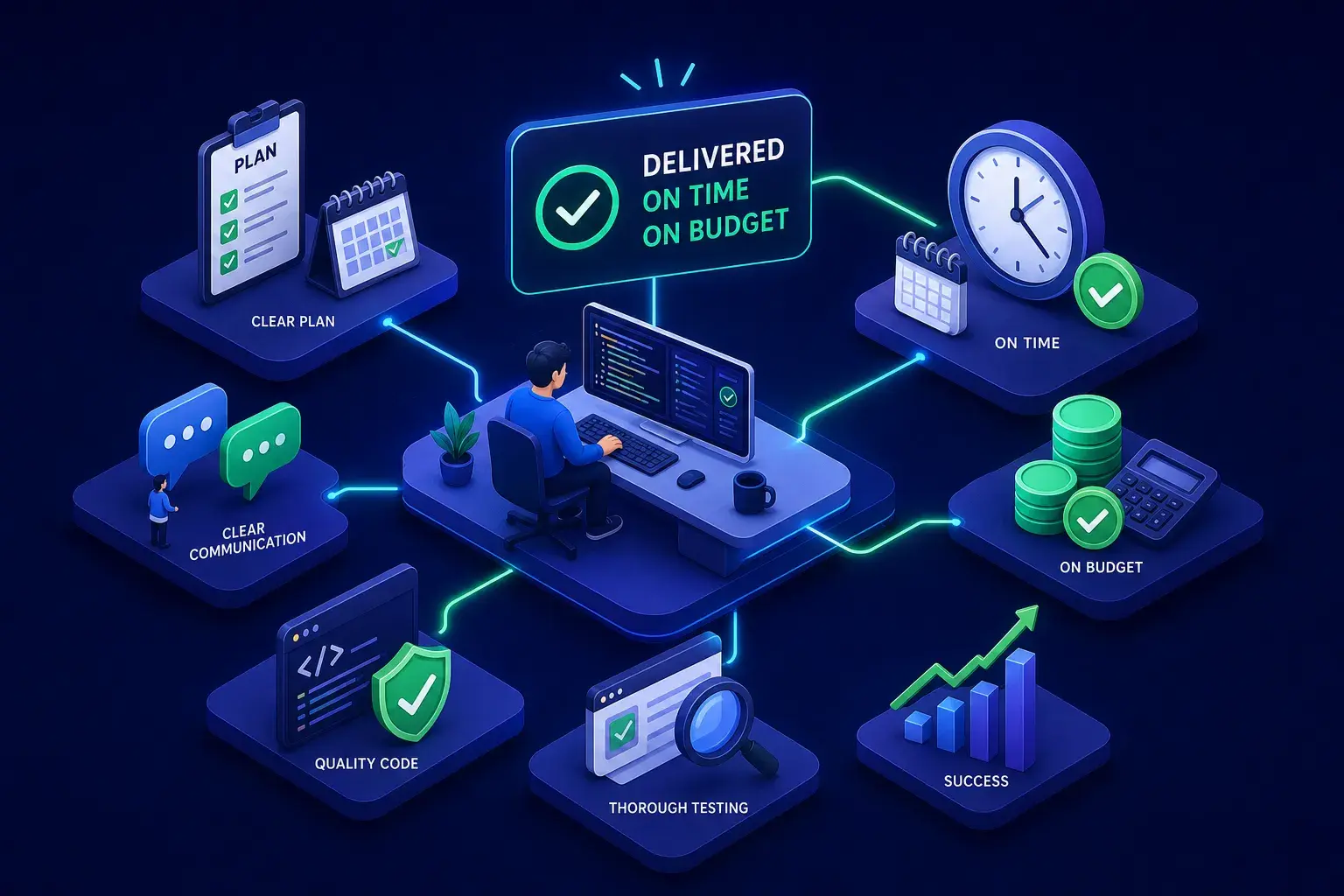
Strong indicators that a web developer will deliver on time and on budget are specific, testable, and visible before you sign anything: they scope the work in writing before quoting, they can show verifiable past projects in your tech stack, their communication process is documented, and they have a clear escalation path for scope changes. Everything else, hourly rate, location, years of experience listed on a CV, is secondary. These signals draw on 500+ completed projects delivered to UK, European, and US clients. Use them as a checklist before hiring and you will substantially reduce the risk before the first line of code is written.
The research behind this is not abstract. According to actitime.com, which summarises findings from large IT project analyses, 39% of project failures stem from changing priorities and scope creep, while unclear requirements account for 35% and poor communication for 29%. The pattern repeats: projects fail during definition and planning, not during development. What follows is a practical guide to spotting the difference before you commit.
Key takeaways
Written scope comes first: A developer who quotes without scoping in writing is a strong indicator of scope creep and budget overruns to come.
Stack match matters: Hiring a front-end developer for a Laravel build adds cost and time before development even starts.
Communication is structural: Reliable remote developers document their process before work begins, not after a problem surfaces.
Portfolio verification is underused: Screenshots prove nothing. Ask for a live walkthrough and specific technical decisions.
Milestones are non-negotiable: A quote with no milestone breakdown cannot be managed or held to account.
AI integration is increasingly expected: For projects requiring AI functionality in 2026, expect AI scoping to be part of the specification, not an afterthought.
What type of web developer does your project actually need?
Getting the developer type wrong is a warning sign in itself. It signals a client who has not thought through requirements, and a developer who accepts briefs they are not equipped to handle. Both errors cost money.
Front-end, back-end and full-stack: a plain-English breakdown
Front-end developers build what users see and interact with: layouts, navigation, forms, and visual components. Back-end developers build the server-side logic, databases, and APIs that power it. Full-stack developers work across both. A front-end developer builds a Shopify product page; a back-end developer builds the stock management API feeding it; a full-stack developer builds both and deploys the integration. The distinction matters because the skills that make someone excellent in one area do not transfer automatically to the others.
Why hiring the wrong type adds time and cost to every project
A front-end-only developer who accepts a Laravel web portal brief will stall at the first API requirement. A back-end specialist asked to handle Elementor layouts will produce something visually unusable. These mismatches almost never surface at kickoff. They appear mid-project, when rework is expensive and timelines have already slipped. A website developer who clearly defines their stack in the first conversation is already ahead of most of the market.
What skills should a professional full-stack developer have in 2026?
The core stack: WordPress, WooCommerce, Laravel and Shopify
Competence in a platform looks different from familiarity with it. A capable WordPress developer builds custom themes and ACF layouts from scratch, not just installs plugins. A WooCommerce developer understands custom checkout logic and shipping rules, not just default store configuration. A Laravel developer builds secure portals with role-based access control, not just basic CRUD applications. A Shopify developer writes Liquid, not just drags sections in the editor.
Each of these distinctions is testable in a portfolio review. Ask to see the specific output, not the logo. A developer who can describe the technical decisions behind a bespoke checkout ruleset is a different proposition from one who shows you a screenshot of a storefront they configured from a template.
AI integration and automation as a modern baseline expectation
For many projects in 2026, AI integration has moved from a nice-to-have to a core scope item that needs careful planning from the outset. Practical examples include an AI chat assistant connected via the OpenAI API, an n8n automation workflow that handles lead routing without manual staff input, and an MCP server processing form submissions through Claude. A full-stack developer working on projects with AI requirements should be able to scope these accurately and build them safely. At Sazzad Hossain, we provide AI integration using the OpenAI and Claude APIs alongside n8n automation workflows as part of our service offering.
How should a reliable web developer scope and quote your project?
What a written scope looks like before quoting begins
A reliable developer asks questions before sending numbers. They need to know the platform, the integrations, the user flows, the content volume, and the third-party services involved. The resulting quote itemises deliverables, not just a total figure. For an online store, that means custom checkout rules, payment gateway configuration, and product import process listed separately. For a web app, it means authentication, user roles, and API endpoints named individually.
Realistic delivery timelines are part of this picture. As a practical reference, a custom WooCommerce store typically requires 8 to 16 weeks, a Shopify build 3 to 8 weeks, and a Laravel portal 12 to 24 weeks, assuming a defined scope and timely client feedback. A quote that promises a complex portal in three weeks is not a bargain; it is a warning.
Project type | Realistic timeline | What drives the range |
Custom WooCommerce store | 8–16 weeks | Custom theme, checkout logic, shipping rules, integrations |
Shopify build | 3–8 weeks | Theme customisation, app integrations, product migration |
Laravel web portal | 12–24 weeks | Authentication, roles, workflows, APIs, security review |
Red flags in a proposal that predict delays and cost overruns
Some warning signs are worth naming plainly:
A quote with no milestone breakdown
A timeline stated in days with no dependency map
A developer who says "we can add that later" when asked about a core feature
A contract with no change-request process
According to actitime.com, which summarises findings from analyses of large IT projects, average cost overruns of 45% are common, while one in six projects experienced an average cost overrun of 200% and a schedule overrun of nearly 70%. These are not edge cases. They repeat consistently in projects that begin with vague briefs and single-line quotes. Use this list as a filter before you sign, not a post-mortem after the project has stalled.
What does good communication look like from a remote developer?
What a structured remote process should include before work starts
A reliable web developer sets up a shared project management tool, agrees on a communication channel, defines response-time expectations, and schedules a standing update, not because they were asked to, but because they know the alternative. For UK clients, this means morning updates timed to overlap with GMT business hours, plus written summaries after calls rather than verbal handshakes. These are not cultural niceties; they are the operational structures that allow a client to know the project is on track without chasing.
Time zone and working-hours alignment for UK and European clients
The useful question is not "are you in a compatible time zone" but "what are your committed overlap hours and how do you document decisions made outside them." A developer working GMT+6 can cover UK morning hours if they structure their day accordingly. The answer to the overlap question tells you far more than a time zone map, and any developer worth hiring should be able to answer it concretely before the project begins.
How to verify that a developer's past work is genuinely theirs
Portfolio review is the most underused filter in developer hiring, most clients look at screenshots, but the useful information is elsewhere.
Project types that reveal a verifiable track record
Across 500+ projects, the work divides into recognisable types that each carry specific technical complexity. A custom WooCommerce store with a multi-tier shipping ruleset and bespoke checkout requires genuine back-end PHP knowledge and WooCommerce hooks, not just theme installation. A secure Laravel client portal with role-based access and an audit trail for compliance requires database design, middleware, and policy logic. An AI-powered lead-qualification workflow built on n8n requires API orchestration, prompt engineering, and fallback design.
Each of these has a specific technical fingerprint. If a developer cannot describe that fingerprint in detail, they were not the one building it.
What to ask in a portfolio review to confirm real involvement
Move beyond "can I see your portfolio." Ask what specific problem the brief presented and how they approached scoping it. Ask what went wrong during the project and how it was resolved. Ask to see a code sample, a staging environment, or a recorded walkthrough of a live build. A developer with genuine depth answers these questions immediately and distinguishes their own work from their teammates'. A developer who assembled screenshots from other people's work stalls, generalises, and cannot name the technical decisions they made. A short verification conversation along these lines is often all it takes to separate the two, though following up with references or a technical test adds further confidence.
How to find and engage a web developer who actually delivers
Freelance, agency or in-house: which makes sense for your budget?
For a one-off build, whether a website, an online store, or a web portal, a freelance full-stack developer with a verifiable track record is often faster and more cost-efficient than an agency for contained projects, depending on scope and agency overheads. Agencies carry account management costs that do not always add value to a defined build. In-house hiring makes sense only when development is continuous and central to the business operation, not for a defined project. For most UK SME projects, freelance full-stack is worth serious consideration.
Starting your first project with a web developer who has done it 500 times
A web developer who has completed 500+ projects has encountered your specific problem before. They know where scope creep tends to appear in a WooCommerce build. They know what security requirements look like for a Laravel portal serving European clients. They know how to build an AI workflow that your team can actually operate after handover. That accumulated pattern-recognition is what on-time, on-budget delivery is actually built on.
Sazzad Hossain has delivered 500+ projects across WordPress, WooCommerce, Shopify, Laravel, and AI integration for UK, European, and US clients over more than ten years. Our core stack covers custom theme and plugin development, secure business portals, Liquid-based Shopify builds, and AI-powered automation using the OpenAI and Claude APIs with n8n workflows. We work directly with UK SMEs, digital agencies requiring white-label development support, and e-commerce businesses needing custom functionality.
If you have a project that needs an experienced web developer with that depth of delivery experience, get in touch to discuss scope and timeline.
Frequently Asked Questions
How risky is accepting a quote that has no milestone breakdown?
Very risky: a quote with no milestone breakdown is a clear warning sign that delays and cost overruns are likely. Large-project analyses show average cost overruns of 45%, with one in six projects experiencing average cost overruns of 200% and schedule overruns near 70%, and starting without milestones makes it hard to manage or hold deliveries to account.
What should we look for when confirming a developer really built the projects in their portfolio?
Ask for specific technical detail and demonstrable artefacts: what problem the brief presented, the technical decisions taken, and evidence such as a code sample, a staging environment, or a recorded walkthrough. A genuine contributor describes the project fingerprint, how custom checkout rules, role-based access, n8n workflows or other technical elements were implemented, and can explain what went wrong and how it was resolved.
How important is AI experience for projects in 2026, and what evidence should we ask for?
AI experience is increasingly a baseline expectation for many projects in 2026, and it should be scoped from the outset. Ask for examples showing API orchestration, prompt engineering, fallback design, or n8n automation workflows connected to OpenAI or Claude, and request demonstrations that the integrations were scoped and built safely.
How should we judge a developer's time-zone and working-hours suitability for a UK-based project?
Judge them by the concrete overlap hours they commit to and how they document decisions made outside those hours. A developer in a different time zone can still cover UK mornings if they structure their day accordingly, and knowing committed overlap and decision-recording practices matters far more than a simple time-zone map.